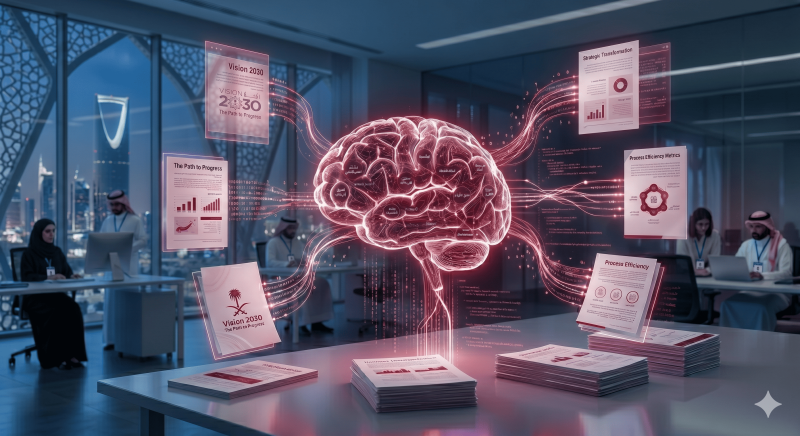
Government Services Automation with AI: The 2026 Strategic Roadmap for Saudi Arabia
As the Kingdom of Saudi Arabia rapidly approaches its pivotal 2030 milestones, Government Services Automation has moved beyond being a mere technical upgrade to becoming a sophisticated national ecosystem. In 2026, the digital shift is no longer just about converting paper forms into digital PDFs; it is about the rise of “Cognitive Governance”—an era where Artificial Intelligence (AI) and Intelligent Process Automation (IPA) anticipate citizen needs and deliver services with zero human intervention.
For Chief Information Officers (CIOs) and digital transformation architects, implementing Government Services Automation is the single most critical step toward achieving the “World-Class Citizen Experience” mandated by the Digital Government Authority (DGA). This transition, however, is complex. It requires a balance between rapid technological adoption and the strict regulatory frameworks governing data sovereignty and cybersecurity in the Kingdom.
1. The Strategic Evolution of Government Services Automation
Historically, automation in the public sector was synonymous with basic Robotic Process Automation (RPA)—software bots designed to replicate repetitive, rules-based tasks like data entry or record lookups. While RPA provided significant efficiency gains, it lacked the “intellectual” capacity to handle unstructured data or complex decision-making. Today, the concept of Government Services Automation has evolved into an intelligent layer that sits at the heart of every government entity.
This modern iteration leverages Generative AI and advanced Machine Learning models. These systems are now capable of reading legal transcripts, understanding nuanced citizen inquiries through Natural Language Processing (NLP), and automatically cross-referencing data against national databases to verify eligibility for social programs or commercial licenses in milliseconds. This is the new standard of public service excellence in the Kingdom.
Furthermore, these intelligent systems are designed to be “API-first,” ensuring they communicate flawlessly with the Saudi Vision 2030 national portals. This integration ensures that Government Services Automation is not a siloed effort but part of a unified “Government-as-a-Platform” model, which is the ultimate goal of the current Saudi digital strategy. By centralizing data and automating workflows, the government can provide a truly seamless experience for its citizens.
2. Why Government Services Automation is Crucial for 2026
A. Radical Reduction in Operational Costs
One of the most immediate benefits of adopting a robust automation framework is the radical optimization of IT and administrative budgets. By automating high-volume, low-complexity tasks, government agencies can reduce their operational overhead by up to 60%. This allows for the redirection of human talent toward more strategic, analytical roles that directly contribute to national development and long-term economic sustainability.
B. Achieving Proactive Citizen Experiences (CX)
In 2026, the citizen is no longer a “customer” waiting in line; they are a “beneficiary” of proactive services. Modern Government Services Automation allows for predictive service delivery—notifying a citizen to renew a document before it expires or automatically calculating social benefits based on real-time life event data. This level of proactive engagement is what separates modern Saudi governance from traditional bureaucratic models.
C. Hyper-Automation and RPA Integration
To achieve full maturity in digital delivery, entities are increasingly turning to Hyper-Automation and RPA. This synergy between robotic precision and AI-driven intelligence allows for the end-to-end automation of complex back-office functions, ensuring that Government Services Automation is not just a front-end interface but a deep-rooted operational transformation.
3. Methodologies for Implementing Government Services Automation
Deploying a national-scale automation project requires a disciplined, multi-phased approach to avoid the common pitfalls of technical debt and system silos:
■ Phase 1: Cognitive Process Discovery: Using AI tools to map current manual workflows and identify the “bottlenecks” that cause delays. This data-driven approach ensures that automation is applied where it will have the highest impact.
■ Phase 2: Business Process Re-engineering (BPR): Before applying technology, we must simplify. Government Services Automation works best when redundant steps are removed, ensuring the digital journey is as lean and fast as possible.
■ Phase 3: Cross-Platform Integration: Connecting the automation layer to national gateways like Nafath and the GSB (Government Service Bus) to ensure a single, seamless identity and data flow across all Saudi agencies.
■ Phase 4: Implementation of AI-Driven Logic: Deploying the intelligent bots and decision-making engines that handle the actual heavy lifting of the service, from document classification to automated approvals.
■ Phase 5: Continuous Optimization: Leveraging real-time performance data to refine the automated processes, ensuring they adapt to new Digital Transformation Services and regulatory updates.
4. Overcoming Regulatory and Technical Challenges
Despite the clear advantages, the path to full digital maturity is paved with challenges. The most significant is Data Sovereignty. In accordance with Saudi law, all sensitive citizen data must be stored and processed within the Kingdom’s geographical borders. This necessitates the use of local, sovereign cloud infrastructures or highly secure on-premise modern environments that support advanced Government Services Automation layers.
Another challenge is Security-by-Design. Every automated workflow must be resilient against modern cyber threats, including AI-driven social engineering and ransomware. This is why automation projects must be built from the ground up with the National Cybersecurity Authority’s (NCA) Essential Cybersecurity Controls (ECC) as the foundational architectural blueprint.
Furthermore, integrating legacy systems with modern AI engines requires a high degree of technical expertise. Many older systems were never designed to communicate via APIs, creating a “technical barrier” to progress. Bridging this gap through middleware or system modernization is a prerequisite for any agency looking to achieve a fully automated service delivery model.
5. Masar: A Sovereign Platform for Government Services Automation
For Saudi entities seeking to bypass the risks of custom-building every solution, the Masar System by Tafeel offers a ready-made, sovereign digital infrastructure. Masar is specifically engineered to handle the unique linguistic and administrative complexities of the Saudi public sector, making it the ideal engine for Government Services Automation.
Intelligent Correspondence (CTS)
Digitizes the entire lifecycle of government mail, including encrypted tracking and certified digital signatures that carry legal weight across all Kingdom agencies.
Digital Committee Governance
By automating scheduling, electronic voting, and the generation of official minutes, Masar ensures that no project is delayed by manual friction.
NCA-Compliant ECM
An enterprise content management system providing high-security archiving that meets all national record-keeping regulations.
Seamless Connectivity
Native connectors for Nafath, SPL (Saudi Post), and the Government Service Bus (GSB), reducing implementation time significantly.
6. Roadmap for CIOs: Deploying Automation in 2026
To ensure a high ROI on your automation investment, start by selecting a “Quick-Win” project—a high-visibility, high-volume service that impacts a large citizen demographic. This builds stakeholder confidence and proves the efficacy of Government Services Automation early in the transformation lifecycle. Following this, agencies should look at deeper back-office processes that support these public-facing services.
Next, focus on building a Center of Excellence (CoE) within your IT department. This internal team will be responsible for standardizing the automation tools used across the agency, ensuring that efforts in the finance department are compatible with those in human resources or citizen services. Consistency is the absolute key to long-term digital sustainability and achieving the goals of the Saudi digital economy.
Conclusion: Leading the Digital Future of the Kingdom
The future of the Saudi public sector is undeniably automated, intelligent, and proactive. By strategically investing in Government Services Automation, government entities are not just modernizing software; they are fulfilling a national promise to provide world-class governance and a superior quality of life for all. Solutions like Masar and services from Tafeel are the essential catalysts for this historic transformation.
Is your institution ready for the next level of digital excellence?
Contact Tafeel’s Experts Today to discover how our Government Services Automation solutions can propel your organization toward the digital goals of Vision 2030.